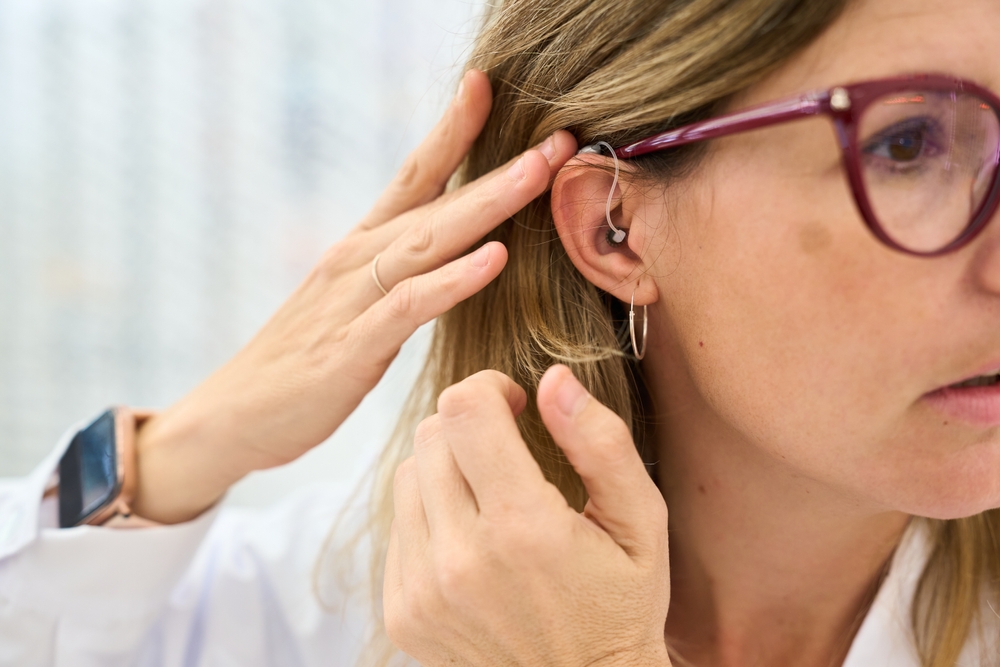
Many people delay getting hearing aids because they don’t think they’ll like how they look or feel. Historically, old-fashioned hearing hardware was bulky, obvious to onlookers, and closely linked with the stigmas of aging. In various scenarios, patients expressed fear that wearing an obvious device would cause peers to omit them from casual conversations due to perceived listening limitations.
For many people, this image has stuck, making them hesitant to take the next step. The liberating truth is that twenty-first-century auditory tech offers a level of cosmetic elegance and physical comfort that surprises most patients. Revolutionary breakthroughs in micro-component miniaturization and ergonomic design have rendered these devices incredibly compact, ultra-lightweight, and virtually unnoticeable.
Should your reluctance stem entirely from memories of obsolete, bulky hardware, you owe it to yourself to discover current medical advancements.
The Hearing Aid You’re Picturing Doesn’t Really Exist Anymore
If you close your eyes to conceptualize a hearing system, your mind likely crafts a picture of a prominent, cumbersome unit draped behind the ear. If that’s the case, you’re thinking about hearing aids circa the 1980s and ’90s.
Over the last few generations, this medical technology category has experienced a total structural evolution. Exponential leaps in digital circuit shrinking, industrial design, and audio computing have totally redefined contemporary hardware. They’re smaller, sleeker, and designed to blend in (or disappear entirely).
A substantial percentage of contemporary options reside deep within the auditory canal, ensuring absolute invisibility during routine face-to-face interactions. Different configurations sit comfortably behind the ear but feature such a low profile and featherweight build that observers naturally miss them.
Navigating Modern Hearing Technology: The Three Core Styles Evaluated
For those investigating what these advanced acoustic tools look like in real life, consider this straightforward guide:
The Invisible-in-Canal (IIC) Form Factor
These are as discreet as it gets. Engineered to rest deep inside the ear canal, IIC systems are individually molded to match the precise contours of your ear. From a normal conversational distance, they’re essentially invisible. They remain an exceptionally sought-after solution for patients with mild-to-moderate deficits who refuse to compromise on cosmetic privacy.
Receiver-in-canal (RIC) / Receiver-in-the-ear (RITE)
This particular layout has become the benchmark standard for contemporary hearing health restoration. A microscopic electronic hub is positioned behind the outer ear, anchored by an ultra-thin, transparent lead to a high-fidelity speaker seated inside the canal. To onlookers, this streamlined design closely mirrors fashionable consumer electronics or sports earbuds. Most people won’t notice them unless they’re looking.
Behind-the-ear (BTE)
These units reside entirely behind the external ear, providing a slightly larger chassis that is still infinitely more elegant than historical variations. Frequently utilized to remediate severe-to-profound auditory loss, they maximize gain and processing capability while maintaining a highly professional, low-profile aesthetic.
The bottom line is simple: modern assistive hearing systems are crafted to serve your life quietly, not to draw attention to your ears.
The Functional Revolution: Modern Instruments Are Tiny Supercomputers
It is vital to recognize that this technological revolution is not simply a visual upgrade. In the current era, these processors operate like sophisticated wearable computers rather than simple analog sound amplifiers. A vast majority feature native Bluetooth connectivity, enabling seamless, wireless streaming of telephonic communication, media, and television audio directly into your auditory pathway.
Equipped with dedicated smartphone applications, they allow users to manipulate volume matrices or toggle environmental programs without making manual physical adjustments. Should you transition into a loud social environment, you can instantly recalibrate your directional microphones via your phone screen. Furthermore, lithium-ion rechargeable cells have entirely eliminated the need to fiddle with microscopic, short-lived zinc-air batteries. The process is as simple as placing the units into their charging dock each night, identical to charging your cell phone.
Empowerment Over Hesitation: Redefining Hearing Health Care
Despite being aware of these massive design improvements, it is entirely normal to feel a sense of hesitation. Acknowledging a sensory deficit and investigating rehabilitation options often forces a difficult confrontation with our own vulnerability and bodily changes. Such moments frequently spark an uncomfortable sense of vulnerability, as though we are losing command over our physical frames.
Let’s reframe this narrative completely: acquiring a modern acoustic instrument is not an admission of weakness. They’re simply a sign of change, which happens to us all. Choosing to hear better is absolute evidence that you are choosing to optimize your body and enhance your overall quality of life.
Imagine wearing a discreet, barely (if at all) visible device and finally being able to follow along in conversation, hear better in crowds, and focus on the things that really interest you. That is a magnificent example of reclaiming control over your life!
Schedule Your Personal Demonstration of Today’s Top Styles
The easiest way to let go of that outdated mental image is to check out for yourself what’s available. We warmly welcome you to tour our practice, consult with our audiologists, and review our product lines with absolutely no financial or purchase obligations. View this consultation simply as a tactile opportunity to discover just how radically changed this technology has truly become.
The overwhelming majority of our patients leave their consultation thoroughly amazed by the compact scale, luxurious comfort, and acoustic clarity of current technology! Call our office to schedule your visit online today.
